

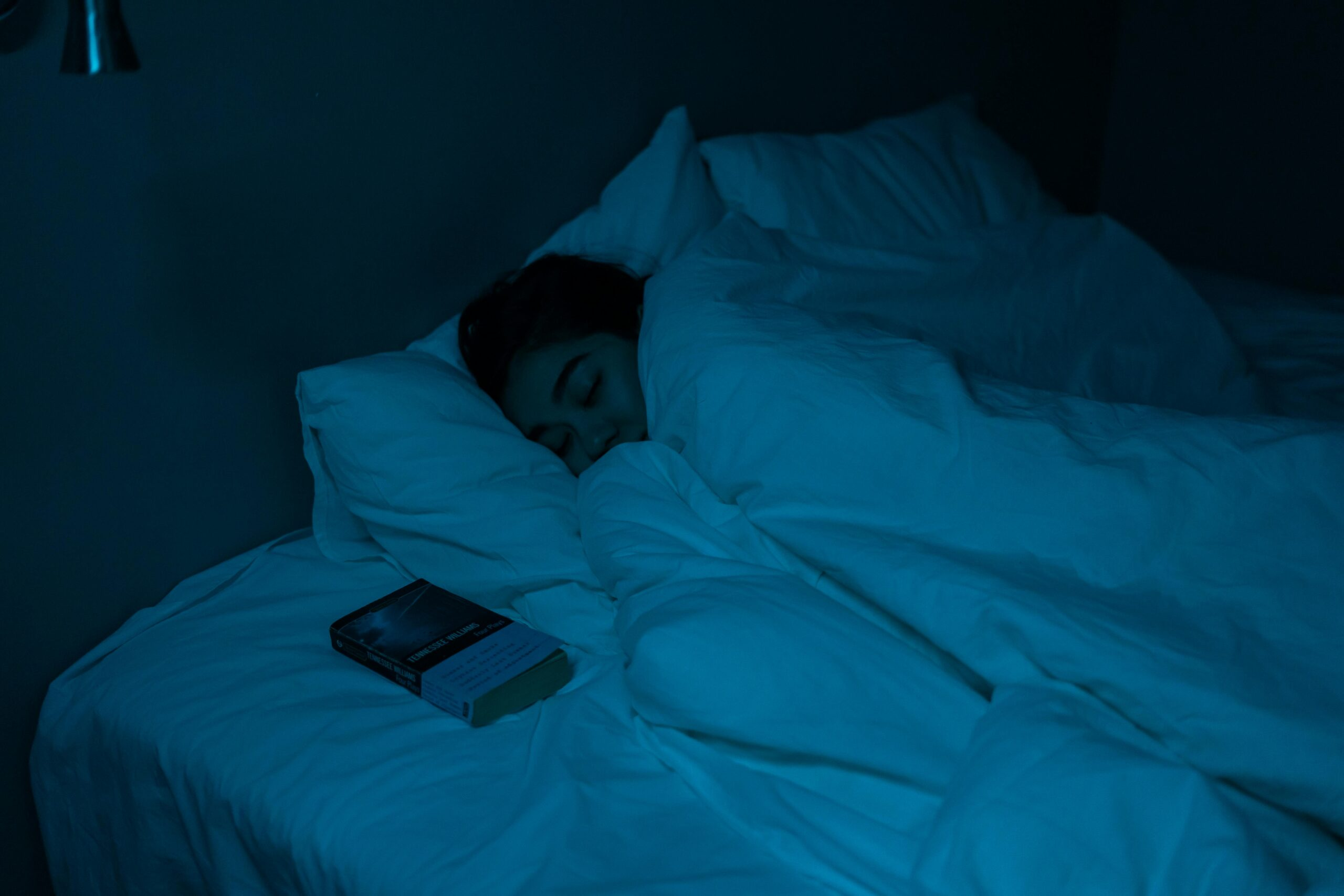
Photo by cottonbro studio from Pexels
Alternative text: A person with dark hair sleeps peacefully in a bed with white linens, illuminated by a cool blue light in a dark room. A paperback book lies on the mattress beside them.
Listen to the Article:
The available audio has been created using OpenAI’s text-to-speech function
I hate getting ready for bed. Capital H HATE. I try to avoid using the h-word but I really cannot avoid it when it comes to the nighttime routine.
For one thing, I’m typically burnt out, already sleepy, and nearly out of spoons (I am referring to the Spoon Theory, which was first developed by Christine Miserandino).
I also don’t enjoy the sensory experiences involved with getting ready for bed: frothy toothpaste that always ends up all over my mouth, water dripping down my arms while washing my face. There’s just very little satisfaction about getting ready for bed.
Because of how much I dreaded the nighttime routine, I found it often burnt me out more and led to harmful consequences. I would have meltdowns over getting ready for bed, and even engage in harmful stims like skin picking (which I talk more about in “How I Stopped Skin Picking for Good”).
When I couldn’t complete my nighttime routine, I’d go to bed depressed and ashamed of myself, which didn’t lead to very restful sleep.
I’ve gotten a lot better over time. I’m not perfect; I still sometimes cannot finish my bedtime routine, and sometimes end the night in a meltdown, but I’m not striving for perfection. It’s just not sustainable, so I hope you’re not aiming for perfection either!
Here are the things that have worked for me over the years in getting through (and sometimes enjoying???) the nighttime routine.
Romanticize the Routine
I find it easier to get through my nighttime routine (and many tasks, generally) when I focus on the little details of the routine and adding elements to make it enjoyable. This may make very little sense, which I totally understand.
Here is the best way I can describe it: Have you ever seen those social media videos of people having these fabulous showers, where they light candles and put aside fluffy towels? Or perhaps you’ve seen a similar video of someone’s morning routine, where they create beautiful coffees and go for morning runs. If you haven’t, here’s one video that I think captures what I’m talking about.
When I romanticize my nighttime routine, I try to imagine I am creating one of those videos, and my eyes are the camera. I incorporate special elements to both enhance the experience while distracting me from the less pleasant aspects of the routine.
For example, I am a big sensory seeker for scents, so I invest in amazing smelling candles that I only light during my nighttime routine. When I have enough energy, I’ll lather myself in sensory-friendly but delicious-smelling body lotions before putting on warm, fuzzy pyjamas. I like to create pyjama outfits so I feel pretty. Even though I’m going nowhere, I spray myself with my favourite body spray.
I know I probably sound crazy. Cameras for eyes and scent overload. The main takeaway is to make your nighttime routine special for yourself, in whatever way you enjoy. Here are some other possible ways to romanticize your routine:
- Putting on your favourite music, podcast, or audiobook
- Having a bathroom-friendly nighttime lamp (I may or may not have gifted this duck lamp to friends…)
- Using fun-flavoured toothpaste (Did you know that kids’ toothpastes often have identical fluoride amounts as adult toothpaste? Kids toothpaste is often a very cheap way to try different flavours like watermelon, strawberry, and bubble gum!)
- Using under eye masks while you get ready (super splurge, but I used to love the Peter Thomas Roth Cucumber Patches, but probably any eye mask will be pleasant)
- Treating yourself with a caffeine-free tea before or after the routine (if you decide to add milk or sugar to the tea and are drinking after the routine, you can rinse your mouth with mouthwash after so that your teeth are still fairly clean)
Listen to Your Body
I don’t romanticize my nighttime routine every night; I can’t. Sometimes I don’t have enough spoons to even change into my pyjamas.
As an overachiever, this can be super upsetting for me. Why is it so hard for me to just get up and just brush my teeth for two minutes? Why am I struggling with something neurotypicals often do on autopilot? It’s during these times I truly feel disabled and hateful to myself.
I used to fight with myself internally a lot when these nights came about. Rather than just listening to my body’s cry for help, I’d push back until I was an angry mess. I eventually realized there’s no point to this.
Whether I like it or not, I’m going to have days when I just don’t have the ability to do a full nighttime routine. If I don’t get mad at myself for being physically limited during chronic pain flare ups, why should I punish myself when I am burnt out?
Permission to do the Bare Minimum
Nowadays, I try to listen to my body to understand what I can achieve out of my nighttime routine. Sometimes I just cannot tolerate flossing, so I skip it entirely or use a floss pick. If I cannot handle flossing or brushing, I’ll see if I can just use mouthwash; anything is better than nothing at all. When I’m extremely burnt out, I can’t even do mouthwash, and that’s okay. I accept that my teeth won’t rot overnight and move on.
I apply the same mentality to my skincare routine. Can I do a full routine? Can I at least wash my face and put on moisturizer? I get extremely nauseated with all the built up gunk on my face at the end of the day, so no matter what, I always wash my face.
Low Spoon Accommodations
There are also many other ways to accommodate yourself during more tiring nights:
- Consider using micellar water wipes on days that you cannot handle face washing. You can also place these wipes nearby your bed, as it may be easier to do this task once you’re already in bed. If you feel comfortable, you can also ask a friend or partner to help wipe your face
- Floss picks aren’t as effective as string floss, but again, it’s better than nothing. You can have these ready in your bathroom and/or by your bed for easier cleaning
- Though I have yet to try them, some people swear by disposable toothbrushes with toothpaste already inside them (like these ones). These again would be great to have by your bed, as they don’t require any rinsing and are easy to use
Whether it’s night or day, you should always be kind to yourself and be understanding of what you can and cannot do.
Distract Yourself
I find it hard to get into autopilot mode during the nighttime routine, but I find it much easier to do so when I distract myself.
I mainly achieve this by watching my favourite show while getting ready for bed (my favourite show is Murdoch Mysteries, which is free to stream on CBC Gem!). I will either stream the show on my phone or ipad and prop it on my counter, and get absorbed in the show while unknowingly getting through my nighttime routine.
Murdoch Mysteries is a murder mystery show (duh), which I find helpful, because I’m also hyperfocused on trying to figure out who committed the crime before the show tells me. You can consider watching your own favourite shows to distract yourself during the nighttime routine, or perhaps try other entertainment, such as podcasts or audiobooks.
Conclusion
I really enjoyed talking about the unbearable nighttime routine! I’ve noticed that since using these skills, it takes less effort for me to complete the nighttime routine, and sometimes I’m able to complete it with very little accommodation!
Is there anything special that you do to get through your nighttime routine? Please share it in the comments below, and let’s start a conversation! Next week I’ll be talking about a very personal topic: Why I didn’t tell my parents I’m autistic, and why I’m okay with that. Until then…

Alternative text: An infographic titled “Surviving Your Nighttime Routine: A Supportive Guide for Neurodivergent Audiences” featuring three steps: “Romanticize the Routine,” “Listen to Your Body (Accommodate),” and “Distract Yourself.” It uses soft, pastel illustrations to suggest sensory-friendly habits, simplified hygiene for low-energy nights, and using media like podcasts to ease the transition to sleep.
The available infographic has been created using Gemini’s nano banana pro
Leave a Reply